Zoe positiveorange

About Zoe positiveorange
Posts by Zoe positiveorange:
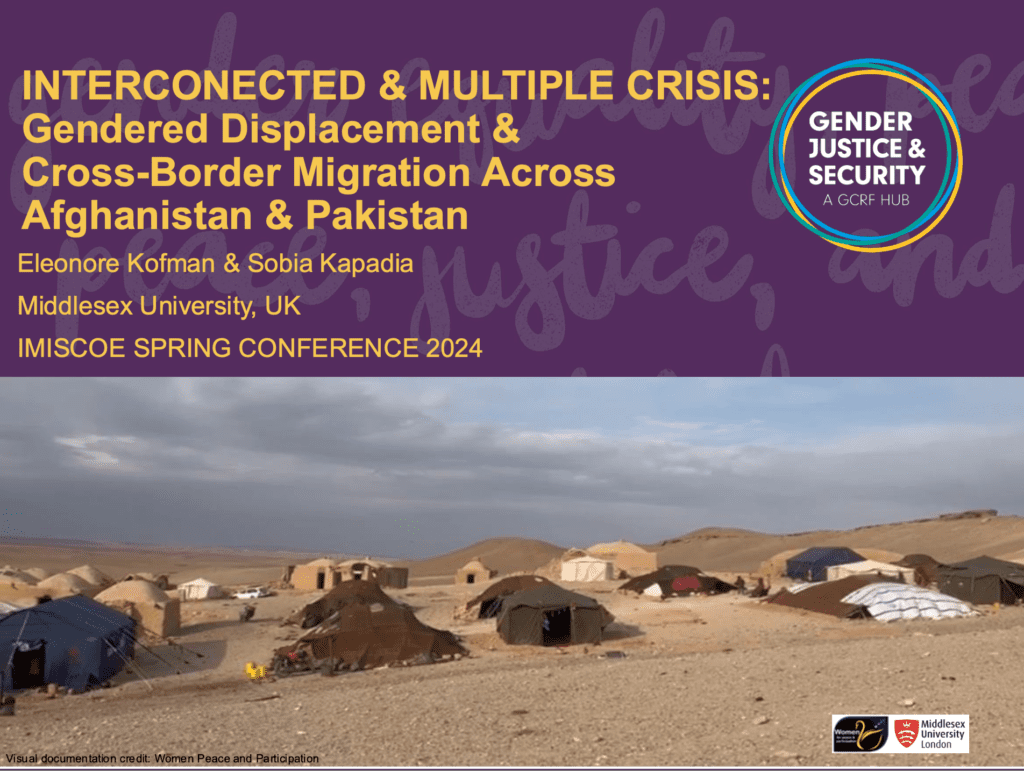
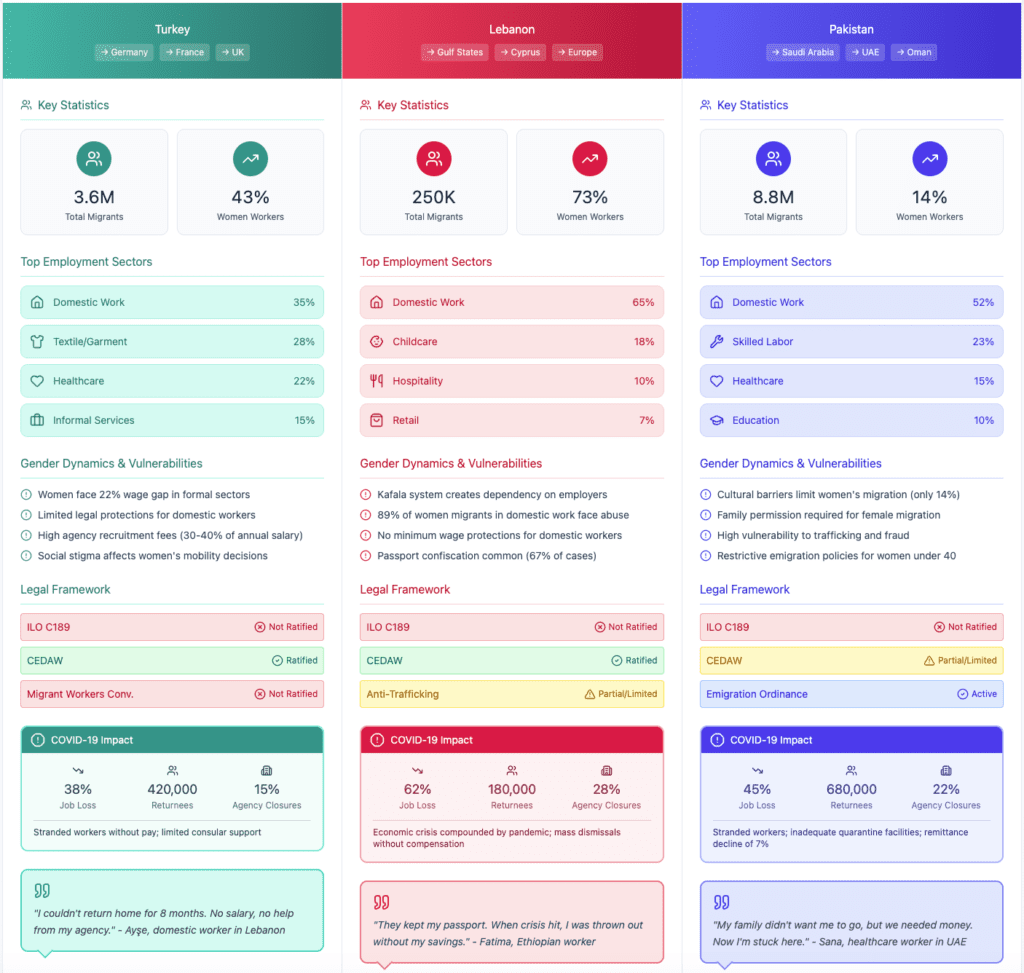
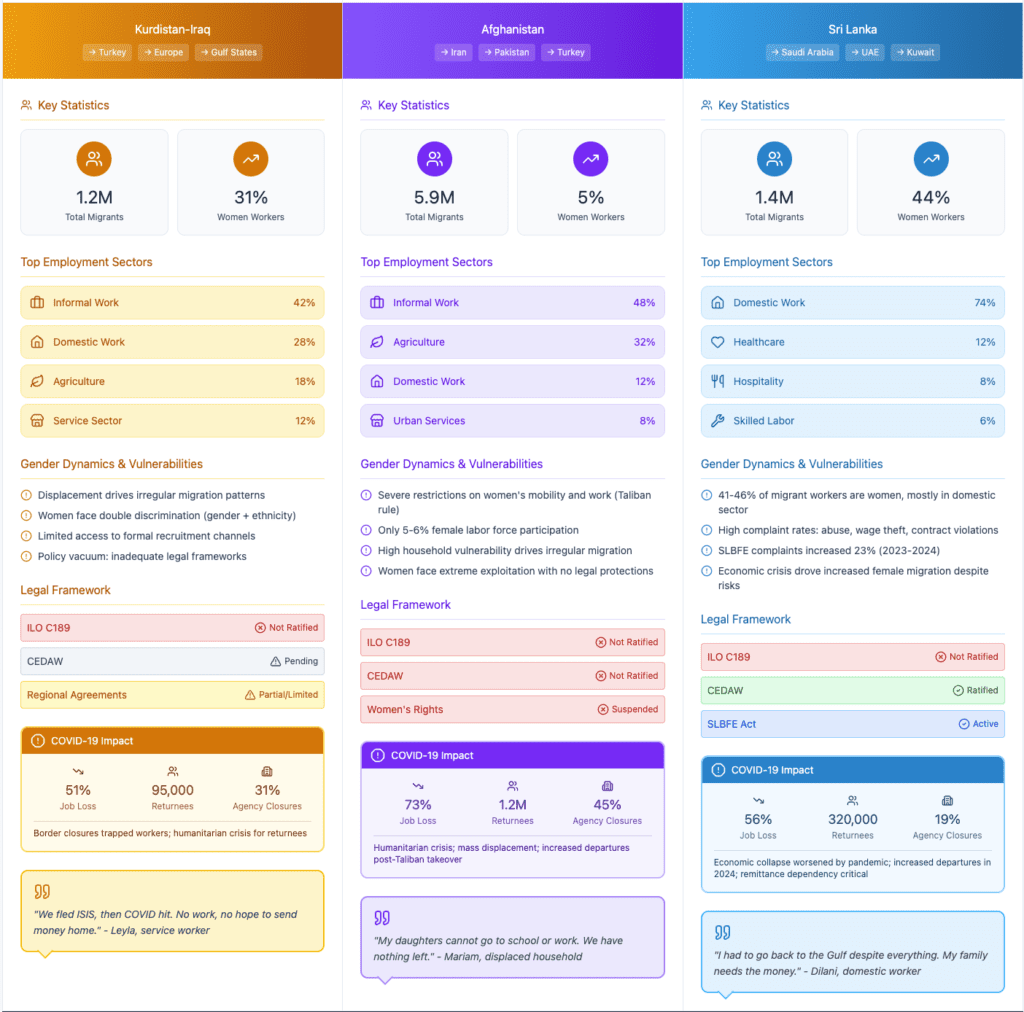
Gendered Labour Migration: Comparison Across South Asia & MENA
This study was part of Gender, Justice, Security Hub.
Research done by Professor Eleonore Kofman, Sobia Kapadia, Dr Runa Lazzarino
Infographic design by Sobia Kapadia.
Joint submission to the United Nations Universal Periodic Review – Sri Lanka
The Gender, Justice and Security Hub (GJS Hub), ICES and UCL submit comments concerning gender and displacement in Jaffna, prosecution of conflict-related sexual violence across the State and land ownership and women’s empowerment for consideration by the Human Rights Council (HRC) within its Universal Periodic Review at its 42nd session.
Creative Economies of Culture in South Asia: Craftspeople and Performers
Much has been written about Kashmiri crafts: their history and provenance, their value to the community that makes and sells them, and about those who buy into the notion of handcrafted. What is seldom examined, however, is the changing nature of these crafts and how they remain at the centre of Kashmiri culture, identity and economy even in times as turbulent as the present. Due to an intractable conflict, fed by ethnic and religious differences, along the Line of Control, which is the de factor border of Indian Kashmir with Pakistan, many generations of Kashmiris have grown up with a ringside view of violence. The conflict in Kashmir has resulted in limited investment and development, and the region risks falling into a spiral of poverty, unemployment and turmoil. Reconstruction is a long and arduous road. According to the World Bank, there are two main objectives: to facilitate transition from war to sustainable peace and to support the resumption of economic and social development, where post‑conflict reconstruction entails rebuilding institutions and jump‑starting the economy (Kreimer 1998). In this chapter, I argue that culturally embedded practices playing a key role in identity creation should also have a role in the reconstruction. Crafts in Kashmir are rich in social significance and cultural value, employ many people and generate significant revenue, which can potentially contribute to economic reconstruction.
Covid-19 Pandemic and the Labour Migrants in the Gulf Cooporation Council (GCC) Region
As of May 15 2020, the six Gulf Corporation Council (GCC) countries; namely Saudi Arabia, the United Arab Emirates (UAE), Qatar, Oman, Kuwait, and Bahrain have recorded approximately 118,739 cases of Covid-19 forcing GCC governments to take drastic measures from restricting economic activities to lockdowns to control the spread of the virus. These containment measures and the pandemic-led reduction in oil prices in the world market are likely to have a substantial negative impact on oil-dependent GCC economies in the coming months and years.
The economic pressures faced by the GCC region, in turn, will adversely affect its labour migrants who account for more than fifty per cent of the GCC labour force. As the vast majority of these migrants are from poor developing nations in South Asia, Africa, East Asia and the Middle East which depend on remittances from the GCC, these countries will be severely affected by the financial pitfalls of the GCC. Sri Lanka also as a labour-sending nation to the GCC region will experience hardships, exacerbating the economic issues the country is already facing due to the pandemic.
Gender and Forced Displacement in Humanitarian Policy Discourse: The Missing Link
This paper reports on a study that examines how gender has been referenced in United Nations (UN), supranational and state documents on forced migration over the past 40 years. It is motivated by the premise that humanitarian protection discourses reflect broader institutional priorities and ideologies and may therefore expose gaps that reveal the relative importance given to the category of gender. The evidence presented below is the result of an extensive review of policy documents on Afghanistan, Kurdistan Region-Iraq (KRI), and Sri Lanka contained in the Refworld database.
The study sought to understand how gender is mentioned in terms of
1. governmentality — a top-down policy preference, which emphasizes the management of humanitarian protection;
2. empowerment — a bottom up policy preference, which emphasizes self-actualization and self-determination: we seek to understand how agency is expressed, including how opportunities for participation feature in policy discourse;
3. inclusion — the scope of coverage of different gender categories in policy discourse; and,
4. differentiation — the particularization of needs, wishes, and demands made by women, men, and girls and boys in displacement settings.
The paper finds:
• Where gender and displacement are discussed together, there is greater emphasis on governmentality, which crowds out other objectives, including advancing opportunities for gender empowerment and participation.
• Internally displaced persons (IDPs) tend to be treated as an operational challenge alongside security and peacebuilding. The nature of their displacement is implicit in these documents, associated within the recurring themes of land, violence, empowerment, and livelihoods. The documents mention violence, but do not widely cover maternal, sexual, and reproductive health.
• The documents offer little insight into the identities of the displaced — whether female, male, children, or members of LGBT communities — and are mostly silent on their specific protection needs.
Overall, the paper finds remarkably little integration of gender within the humanitarian literature on forced displacement. In spite of much advocacy by the UN, the concept of gender has not been effectively disaggregated to address the specific needs of IDPs, especially in the discussion of children. This paper argues that taking gender seriously means recognizing how protection needs may be shaped by power relationships, and how policy and practice would be enhanced by a more nuanced understanding of how vulnerabilities and opportunities are structured by gender and the specificities of the displacement context. It recommends that the United Nations High Commissioner for Refugees (UNHCR) and partner UN agencies continue to find opportunities to bring humanitarian policy on gender and forced displacement into conversation in order to strengthen protection. To this end, it suggests that the concept of gender should be disaggregated to address the specific needs of displaced people, to reflect the wider range of identities of displaced people, and to foster opportunities for their empowerment, and participation.
Secluded Lives: Restricted Urban Practices of Migrant Domestic and Care Workers in Istanbul
Our research investigates the gendered processes of labour migration of domestic and care workers (MDWs), along with their experiences of urban life in Istanbul. As an interdisciplinary urban study in concordance with ethnographic methodologies, it further focuses on gendered drivers of migration: the home, work, and social urban environments of MDWs. The significance of our study is that it contributes to analyses of Global South–South female labour migration from a gender perspective, which has emerged as a relatively new and burgeoning field in migration studies. It is also significant in that it reveals how gender inequalities are spatialised. This is done by representing the city through the digital mapping of anonymous information from MDWs concerning their use of Istanbul.
Our findings state that the urban practices of MDWs are highly limited and restricted by patriarchal family structures, either remote husbands or transnational communities. The fear of being a foreign woman in Istanbul, language barriers, illegal status, and the expensive costs of socialising outdoors restricted their urban social lives as well. Furthermore, the host community sometimes stigmatises foreign women as “easily exploited”, thus, most were exposed to verbal, physical, and/or sexual harassment in public spaces, which caused women to lead secluded lives. Fearing male violence, which is widespread in Turkey, they censor themselves. In this sense, gender inequalities seem to be spatialised; this can be traced through Google My Maps based on the subjective urban narratives of MDWs. It represents how urban policies remain insufficient in responding to feminised labour migration.
Gendered Dynamics of International Labour Migration: Migrant Domestic and Care Workers in Istanbul
The aim of this report is to understand and analyse the living and working conditions of migrant domestic and care workers in Istanbul through several themes, such as drivers for migration, living/working experiences and practices, and migrant women’s spatial mobility in the city. Based on migrant women’s own narratives, this report also discusses the impacts of the Covid-19 pandemic on the employment of domestic and care workers. It contributes to a better understanding of South-South migration for which there have still been relatively few studies of the dynamics and migration patterns. This report is based on the Gendered Dynamics of International Labour Migration project funded by the UKRI Gender, Justice and Security Hub.
The report seeks to avoid a perspective that sees migrant women only as victims of the process of migration and therefore, has a perspective that highlights women’s agency and brings their voices to the fore. While women’s subject positions are understood within structural conditions (such as the labour market, national regulations on visas, work/residence permits, gendered drivers of migration that effect their decisions to leave their countries of origin and so on), their strategies to cope with the working and living conditions are taken into consideration.
Its findings draw on 12 in-depth interviews conducted in Istanbul as well as two branches of IMECE, the union of domestic workers. Thus, based on original data gathered for the project and rich feminist literature on working conditions and experiences of migrant domestic/care workers (MDW) in Turkey, this report contributes to the existing literature on South-South migration, transformation of welfare states and care regime(s), stratification of the care market in Turkey based on gender and nationality, as well as migrant women’s agency from a feminist perspective.
The report is composed of five main parts. The introduction gives a brief overview of the care regime and the welfare state as well as legal framework for MDWs in Turkey. This is followed by a section on the Methodology. The third part of the report concentrates on the act of migration and women’s work experiences and practices from a gender perspective. This part also includes women’s coping strategies in response to their experience and explores agency. The fourth part concentrates on their public access and spatial mobility before the Covid-19 outbreak. Finally, the report concludes with the main findings of the projects.
Gendered Dynamics of International Labour Migration: Skilled Female Migrants in Istanbul
The first part of our research aims to investigate the gendered dynamics of labour migration of skilled (university graduate) more highly educated migrant women working and living in Istanbul, along with their experiences in urban space. This project further focuses on the drivers and processes of migration and urban life (home, work, socialising) experiences in both countries of origin and Istanbul of skilled women who have migrated to Turkey to live and work from countries in both the Global North (high economic welfare level) and Global South (middle and low economic welfare level) (Solarz, 2020, Fiddian-Qasmiyeh, 2020, Garcés-Mascareñas 2018) in the context of gender inequalities.
The significance of this project is that it contributes to analyses of the Global North-to-South and South-to-South skilled female labour migration from a gender perspective, which has emerged as a relatively new and burgeoning trend in migration studies in recent years. Among these trends, skilled female migration, particularly to countries in the Global South, has been largely ignored. Although this phenomenon has become widespread in Turkey as an upper-middle-income country, Turkey’s potential in the context of its intake of skilled migration has yet to be included in the global literature. This project helps reveal the importance of skilled female employment in Istanbul by revealing that the migration flows from the Global South to Turkey do not only include international asylum seekers, refugees, less skilled male workers, and by emphasizing the socio-cultural accumulations and economic potentials of Istanbul as a global city. Another significant value of the project is to map migrant women’s experiences in private and public spaces, as well as their mobility networks in the city, in order to reveal how gender inequalities are spatialised and how they reproduce urban space, which will contribute to urban studies focusing on Istanbul.
Based on empirical fieldwork and qualitative analysis, this socio-spatial research employs an interdisciplinary approach combining ethnographic methods, participant observation, in-depth interviews and urban studies approaches. Furthermore, it uses urban mapping of anonymous information concerning the use of public space with an analytical account of gender-based discrimination encountered in public spaces and sexual harassment experienced by migrant women, as well as their opportunities to access public facilities and places and mobility in Istanbul.